


Kamala Harris: “We cannot support and help our young people if we don’t also look at the context in which those young…
Equity in First Nations Census Data: A Tribute to Edna Paisano (1948-2014)

Image credit
With the US federal workforce, equity and inclusiveness, and government statistics all under assault, it’s timely to consider the effort it took to build what’s being vandalized now – and to honor the people who did that work. With federal data systems and the integrity of the census at risk, the American Statistical Association Executive Director warned that, without a reversal of the current trajectory, we will “watch America’s statistical infrastructure crumble.”
The US Census is a central pillar of that infrastructure. It’s the basis for apportioning seats in Congress, as well as determining allocation of much federal funding. And that’s what drew Edna Paisano to work on it. She grew up on an Indian reservation, and appreciated the critical role the 10-yearly Census played for communities like hers.
The first time Indians were officially included in the Census without restrictions based on where they lived was 1940. The Indian Citizenship Act had only passed in 1924. However, it wasn’t until the 1970 Census that First Nations people could self-identify on questionnaires they mailed back, though this was partially introduced for the 1960 Census. Up to then, race and tribal affiliation “relied on the opinion of the enumerator.” The enumerators were government employees who went door-to-door collecting data, and back then, they weren’t from the local communities.
In June 1976, Paisano was appointed to a newly created position in the Racial Statistics Branch of the US Census Bureau. She was the first Native American to become a full-time employee of the Bureau, and her role was to address the inadequacies of Census data on First Nations people. Paisano was only 28 years old, but she had a skill set and life experience that equipped her for the herculean task needed to improve the counting of indigenous peoples and analysis of the data.
Edna Lee Paisano was born on New Year’s Day in 1948, on Nez Perce tribal land in Sweetwater, Idaho – a tiny rural community. Her mother was Nez Perce and her father was Laguna Pueblo. She was one of 4 children, including an older sister who died in very young adulthood. The family included their maternal grandparents, and thanks in large part to her grandmother, Paisano grew up steeped in Nez Perce traditions.
Most Indian people on reservations in the 1950s and 60s were living in poverty. Both of Paisano’s parents worked, as did her grandfather, but that wasn’t enough: Incomes on reservations were far below national averages. The family’s diet was supplemented by hunting, fishing, gardening, and gathering traditional food. They ate moose, elk, and venison, and smoked meat in a tepee. The family’s income was supplemented by raising some cattle, and her grandmother’s crafting of moccasins and beaded purses from cow hides. There is a photo of Paisano in a beautiful buckskin and bead traditional dress her grandmother made her.
From childhood, she was committed to learning how to improve life for her tribe and community. That meant leaving the reservation to get an education. Opportunities were very limited for girls on reservations in the 50s and 60s. Paisano’s favorite subject was mathematics but, as she later wrote, she had “limited exposure to math-related occupations.” When she graduated from the local high school in 1966, she enrolled at Boise State University studying for a Bachelor of Arts in sociology, taking every mathematic- and statistics-related course available. Paisano transferred to the University of Washington in Seattle after a a couple of years. Some of the jobs she did to support herself while studying included being a park ranger, dormitory student advisor, and recruiter of Native American students for the university.
In her first year in Seattle, Paisano was suddenly unable to walk one morning – she had developed severe rheumatoid arthritis, and spent much of that year in hospital. It was the beginning of lifelong disability. Years later she would recall, “It was very hard. I used to play softball and swim almost every day, and now even walking is sometimes difficult.”
While she was a student there, Seattle was a major center of Indian activism. A highlight of Paisano’s involvement was with the historic Fort Lawton takeover. In 1970, community leader Bernie Whitebear spearheaded a campaign to invoke Treaty rights for Indians in Seattle when the US Army decided to decommission their base at Fort Lawton: Should government lands become available, Indians were supposed to get first refusal to the land. That had never been previously honored.
It took a massive effort for Seattle Indians to achieve a land base there for cultural and community support. When normal channels weren’t working, Whitebear and supporters scaled the Army’s fence and occupied the land. Paisano was one of the protesting occupiers.
Indians invading a US Army fort quickly gained a lot of attention, including from international media. Dozens were arrested, including Paisano, who was imprisoned for a few hours. After a long campaign and a lot of negotiation, 20 acres were ceded to the Indian community, which became home to the beautiful and inspiring Daybreak Star Cultural Center.
You can read more about the Fort Lawton takeover here; there’s another short video here; and there’s a documentary about Bernie Whitebear and the Fort Lawton campaign here. There’s a collection of news coverage here (including several stories of Jane Fonda’s participation in the occupation to raise awareness).
Paisano graduated the next year, and went on to postgraduate study. She was awarded a masters degree in social work in 1973, and spent some time as a social worker in the Public Health Hospital in Seattle, where many of her patients were from reservations. She then worked for the Head Start program, spending time with tribal governments in the west, as well as migrant camps.
After that, she spent some time in a consulting firm, supporting tribal governments, but arthritis made the extensive travel too tiring. (Paisano had had her first hip replacement in 1974.) She needed to find a way to help her community that settled her in one place: That led her to the federal government in Washington DC in 1976, and the new position at the Census Bureau. “They had no one to give them our point of view,” she would later recall, “I was able to do something new. I was able to provide connections between the Census Bureau and tribal governments and other federal agencies…With American Indian issues, it is very important to have people who can interpret the data accurately.”
When Paisano arrived, there wasn’t a lot of time till the next Census, due in 1980. Still, she was able to initiate the Bureau’s first-ever series of meetings with First Nations representatives, even though it was late in the process. With a co-worker, she constructed a special questionnaire for people living on reservations and former reservations, piloting it to refine the questions. A sample of approximately 80% of households with at least one First Nations person received the questionnaire.
Lorenda Sanchez, of the Yerington Paiute Tribe, worked with Paisano on the 1980 Census. She said that Paisano examined data and visited tribal communities, concluding that there had been serious undercounting.
Undercounting was particularly problematic for people living on reservations, and it has severe consequences. An undercount of a handful of percentage points can end up costing several thousand dollars per person. There’s a concise overview of studies of undercounting and the socio-historical context in an excellent white paper by professor of American Indian Studies, Carol Lujan, of the Diné (Navajo) nation. Studies involve comparing Census results with those from other government agency data collections and/or ethnographic studies.
Undercounts of only a few percent to as high as 65% had been identified on reservations up to 1970. Contributing factors include high population mobility; mistrust of government agents; and methodological issues, including definitions, culturally biased methods, and language barriers. Methodological problems are extensive – like enumerators having inaccurate maps, so that entire communities on individual reservations were missed.
Paisano tackled the map issue. She reported that in 1987, the Bureau reached an agreement with the Bureau of Indian Affairs to ensure there were accurate, certified maps. In 1985, the Bureau had also established a representative Advisory Committee on the American Indian and Alaska Native Populations for the 1990 Census, as well as a Task Force within the Bureau. The liaison program was impressively extensive, with liaisons recruited at tribal level, regional meetings, and indigenous enumerators. It was backed up with promotional materials for education campaigns, including posters and videotapes. Here’s an excerpt from Paisano’s description to give you an idea of the scope of this:
“In planning for the 1990 census, we decided to ask each tribe and village to appoint an official liaison. The concept was tested in the 1986 test census in Mississippi with that State’s Choctaw tribe. Then it was tested again in the 1987 test census in North Dakota with the Devil’s Lake Sioux and the Turtle Mountain Chippewa tribes. These tests were successful and the program was implemented in the 1988 Dress Rehearsal with the Colville and Spokane tribes. Also, our debriefing of these liaisons in the test censuses and dress rehearsals was the basis for the manual and training provided to the tribal and village liaisons for the ’90 census.”
There’s a formal description of the program here. Tribes and villages were consulted on the accuracy of maps in 1989, and they received the Census data for their communities afterwards. On top of all that, Paisano had the ordinary management and statistical work, plus the tasks of a federal employee – writing reports and preparing speeches and congressional testimony for higher ups.
In the end, there was a 38% increase in the number of First Nations people in the 1990 Census, which, Paisano wrote, “cannot be attributed only to natural increase” in the population. Contributing factors she listed included better Census methods and outreach, as well as “a greater propensity in 1990 than in earlier censuses for individuals (especially those of mixed Indian and non-Indian parentage) to report themselves as American Indian.”
Undercounting remained a critical problem, but the Census’ methods had been radically improved. Altogether, Paisano worked at the Census Bureau for 20 years. She left for a role at the Environmental Protection Agency, and after a short stint there, became the principal statistician at the Indian Health Service for the remainder of her career.
In an interview late in her time at the Census Bureau, Paisano said, “In the end, I’d like to live back on the reservation – like coming full circle. Going out, then coming back, to share all I’ve learned.” When she retired from federal service in 2011, she was able to fulfill that ambition, returning to Sweetwater. Paisano died in Idaho in 2014. She was 66.
A part of Paisano’s legacy is the encouragement she gave to others throughout her career: “I encourage students, especially American Indians and Alaska Natives, to get majors in mathematics, statistics, computer science, or geography because there are only a small number of us in these jobs. These are important fields that have satisfying careers, but they also benefit our people, tribes, and communities.”
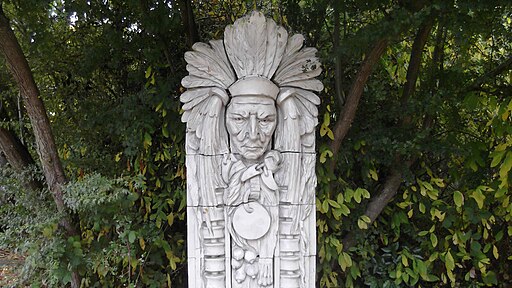
Image credit
Guardian of the Spirit at the Daybreak Star Indian Cultural Center in Seattle: “This guardian watches over our land so that all who visit here are under his protection.”
~~~~
You can keep up with my work at my newsletter, Living With Evidence. I’m active on Mastodon, @hildabast@mastodon.online, and on Bluesky.
Sources for biographical details and quotes in this post:
- Chapter by Edna Paisano in a book from the Mathematical Association of America, 101 Careers in Mathematics (2014) (This is digitized at Cambridge, behind a paywall.)
- Teri Perl, Women and Numbers: Lives of Women Mathematicians (1993) (On the Internet Archive.)
- Obituary, The Lewiston Tribune (2014)