
Decision-making about drugs in pregnancy can be very difficult. Our illogical aversion to clinical trials in pregnancy means people making particularly complex…
This Evidence Fundamentally Shifts the Debate About the HPV Vaccine
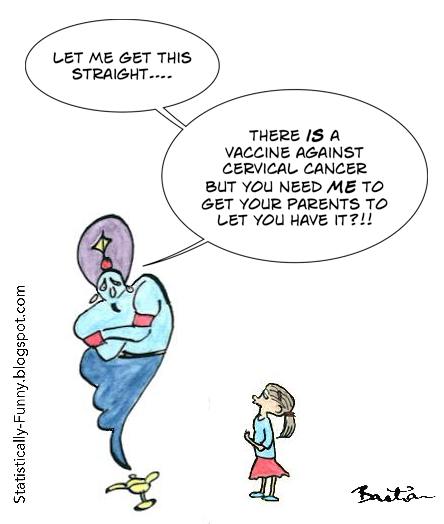
Image credit
Cartoon by Hilda Bastian, CC BY-NC-ND 4.0
We’ve had to wait a long time to get to this point. If cervical cancer develops after HPV infection, it will take many years to become invasive, life-threatening disease. It is typically a disease of middle or old age. The very young teens vaccinated in the first major campaigns are still only reaching their early 30s. It’s not long enough yet to see the full impact of vaccination on cervical and other HPV-related cancer – especially as vaccination extended across gender lines didn’t start till later still.
However, a new pair of Cochrane systematic reviews published today marks an important milestone, resolving core questions both about the effectiveness of the vaccines, and the strength of the evidence (Bergman 2025, Henschke 2025). These reviews are whoppers – with 860 pages and 285 studies between them, covering over 132 million people. Before I get to them, I think starting this story earlier shows why these reviews fundamentally shift the debate.
Firstly, however, I need to note that I was involved in the development of these reviews (but not as an author). Plus, I’ve been participating in arguments about this vaccine since 2009, so I have a lot of disclosures listed below.
These vaccines were a magnet for controversy from the start – and not just because they are at the volatile intersection of children, sexually transmitted infection, and vaccines. They provided fertile ground for evidence disputes, too, initially about the clinical trials that launched them into community use, and then about the systematic reviews of those trials.
The roots of all this are in the nature of HPV infection and its relationship to cervical and some other cancers. HPV is sexually transmitted. These viruses are very common, but most of the time they don’t cause a life-threatening problem. The infection usually clears up, though it can often cause genital warts. But if infection persists for a few years, collections of abnormal cells called lesions can develop. The most common lesions are CIN (cervical intraepithelial neoplasia), and sometimes AIS (adenocarcinoma in situ). These can, in turn, develop into cancer, but again, most of the time they don’t. Nevertheless, they are called precancer, or precancerous lesions.
There’s a worryingly high chance that the more advanced forms might go on to become cancer years later – maybe 15% or more of the time for CIN2 and CIN3 (see my 2018 post). Because cervical cancer is such an awful and life-threatening disease, CIN is the target of cancer screening in many well-to-do countries, with the aim of preventing at least some cancer by treating CIN2 and CIN3.
Testing for HPV infection and lesions involves genital examination and samples. So HPV vaccine trial participants were going to have repeated genital examinations and Pap smears. This set up a peculiar layer of complexity from an evidence point of view: You couldn’t ask that of thousands of very young girls. But the theory of cancer prevention with this vaccine ideally meant getting it before you ever had a chance to be exposed to HPV infection. By the time teenagers were old enough to ethically be recruited to a study with lots of genital examinations, many were already sexually active and vaccination would probably be less effective. But the vaccine simply couldn’t be tested in the target population.
For the evidence community, this meant that the trials were saddled with a couple of major limitations right from the start. Not only weren’t they being done in the target population, the outcomes being measured weren’t long-distant cervical cancer, but the early signs of infection and lesions. These kinds of probabilistic substitutes for the “real” outcomes are called surrogate outcomes or biomarkers, and are generally regarded as less reliable evidence. Here’s an explainer I wrote on that back in 2014.
This set up a schism at the outset. There were people seriously skeptical of the vaccine trials for these reasons – along with the usual issue that trials for as-yet unapproved drugs are going to be run by manufacturers, another potential source of bias exaggerating effectiveness.
Ordinarily, I would have been one of them. I wasn’t though. That was in part because the results would likely be under-estimating the potential for vaccine effectiveness. And in part because I didn’t regard CIN as only a surrogate for cervical cancer: Preventing abnormal cervical screening results and the cascade that follows is directly valuable.
While cervical cancer is thankfully uncommon, scary screening results are not. Before HPV vaccination, about 2 million a year in the US alone would get abnormal results, very often leaving them up in the air about whether or not they might be getting cancer. For perhaps a couple of hundred thousand there would be treatment for CIN2 and CIN3, which can be distressing and painful, with the potential for long term reproductive problems. Millions stood to benefit, even if they never were going to get cervical cancer anyway.
Back in the early days of the vaccine, there were other layers of complexity as well. Once it became clear that the vaccine was very effective, participants who had been randomized to placebo groups tended to be offered vaccination at the end of trials. Many of them got vaccinated – which they could have done when the vaccines rolled out, as well. That reduced the power of the trials to assess long term vaccine effects in a straightforward way.
Early on, too, skeptics often stressed that we had no idea of how durable the vaccine was going to be, and whether or not suppressing some strains of HPV would result in other cancer-causing strains taking their place – meaning cervical cancer could rebound. This didn’t convince me to be hesitant about the vaccine, though, because even if only a generation or two were spared cervical cancer, that would still be wonderful.
Some were concerned that the vaccine might affect sexual behavior – encouraging promiscuity, for example. To me, that seemed unlikely, and it signaled the need for improved education: Young people needed to know this vaccine offered no protection against other sexually transmitted disease.
There was another critical reason for a schism within some parts of the evidence community. More extreme critics of the vaccine argued the intervention was unnecessary, because screening meant that cervical cancer was already “preventable.” This was objectionable to many of us for two critical reasons. First and foremost, because this threw a huge part of the world’s population under the bus: They live in countries that can afford neither massive screening programs nor the best treatments.
Secondly, it meant applying an evidence double standard. The level of evidence being demanded for the vaccine’s introduction was far higher than the level of evidence for screening programs. Back in the day they were introduced, large placebo-controlled trials weren’t expected, and once the programs were the standard of care, it was too late to do them. (Another disclosure: I’ve a long history of being critical of the evidence base for cervical cancer screening.)
Over time, the ground shifted. The vaccine’s trajectory meant the arguments about durability and potential viral changes receded. Not only was it clear that this wasn’t going to only be short-term protection – there is even a single-shot course – but the vaccine which began as monovalent – targeting only one strain of HPV – became multivalent. There’s one that targets 9 strains.
Vaccine criticism increasingly focused on claims of adverse effects. That’s easy to do, and the scare-mongering it feeds is hard to rebut. Once an entire generation is getting an intervention at once, if you lower the evidence bar it’s easy to claim associations with a range of coincidental misfortune.
In 2018, yet another layer of complexity was added. A Cochrane review of the randomized vaccine trials was published, and it was an easy target for critics who launched what I called a spin- and error-based salvo. A very public conflict exploded, triggering a major forensic audit by Cochrane. In 2020, a competing systematic review critical of the vaccine and the evidence was published in another journal. If you’re interested in all the gory details, you can dig in via the disclosures below this post.
One of the results of this bruising episode was that Cochrane now had a serious opportunity. Along with their own audit, there was a detailed roadmap for the methodological standards critics demanded for assessing the evidence on the effects of HPV vaccines – including analyzing clinical study reports for randomized trials (not just journal publications), and considering non-randomized evidence on safety. In 2020, I wrote, “Here’s hoping they take full advantage of it.”
They did. They started from scratch, with a new team. They set out to do 2 major, complementary reviews: One of randomized trials, including clinical study reports, with a network meta-analysis. (My explainer on that type of meta-analysis here.) The other, on community studies of the impact of the vaccine, including both positive and negative potential effects. And I got to participate, ensuring that they did in fact take advantage of critics’ points of view. The years it took to do this also saw the evidence of impact on disease grow. Now, the original criticisms about relying on “surrogate” outcomes no longer apply.
Sure, meeting people’s evidence demands is never a guarantee of satisfying them: Goal posts can just be shifted – and new questions arise, anyway. No reviews can be perfect – especially not when they are this big, and this complicated. There are still limits to this historical evidence, of course. Much of it applies to earlier vaccines, gender-neutral vaccination has a shorter history, and it’s too early, too, for strong evidence on the HPV-related cancers that are less common. We don’t have randomized evidence for the under-15 target population.
What about the non-randomized evidence we do have? This is what Nicholas Henschke and colleagues included (after a final update search in September 2024):
“We included 225 studies from 347 records in this review, evaluating over 132 million people. We included 86 cohort studies, four case‐control studies, 46 cross‐sectional studies, 69 pre‐post vaccine introduction studies, five RCT extensions and two self‐controlled case series. Thirteen additional studies reported on more than one type of analysis. Of the included studies, 177 reported only on females, 11 only males and 37 a combination of males and females. Risk of bias ranged from overall moderate risk to critical risk.”
From the subset that could be meta-analyzed: “For those vaccinated at or before 16 years of age, covering 4.54 million person‐years, there was an 80% reduced risk of cervical cancer (RR 0.20, 95% CI 0.09 to 0.44; I2 = 69%).” In addition, “There is evidence that HPV vaccination does not increase the risk of the most common adverse events reported on social media.”
That is the fundamental shift. We don’t have to rely only on models of what the vaccine might do, or pick and choose some primary studies to try to convince people to join the fight to eliminate cervical cancer. There are influencers and their audiences captured in an HPV-vaccine-critical feedback loop, and that is sure to continue. But the weight of the evidence has tipped heavily in favor of HPV vaccination.
Thank you to Hanna Bergman, Nicholas Henschke, and all the authors of the new reviews, as well as the Independent Advisory Group for the pair of reviews of the effects of the vaccine – and a massive thank you to the many tens of thousands of young people who participated in the randomized trials of the HPV vaccine.
Further information:
Here’s Cochrane’s press release about the pair of reviews, and here’s their press release about the results of a qualitative Cochrane review from earlier this year on adolescent and caregiver views about the vaccine. Cochrane has produced an FAQ about the vaccine, here. And the authors of the qualitative review have written a post for healthcare professionals about navigating hesitancy about the HPV vaccine.
The reviews:
- The network meta-analysis (Bergman 2025)
- The review of community studies (Henschke 2025)
- The qualitative review (Cooper 2025)
~~~~
The cartoon is my own (CC BY-NC-ND license). (More cartoons at Statistically Funny.)
Disclosures: I led an Independent Advisory Group for this new pair of Cochrane reviews on the HPV vaccine (members listed below), with financial support from 2021 to 2023. I provided extensive input into the protocols and full reviews (including first and updated versions). My personal interest in understanding the evidence about the HPV vaccine is as a grandmother (of a boy and 2 girls). I have no financial or professional conflicts of interest in relation to the HPV vaccine.
I have a long professional history in relation to the evidence on the HPV vaccine. I led the development of a fact sheet and evaluation of evidence on HPV vaccine for consumers in 2009 for Germany’s national evidence agency, the Institute for Quality and Efficiency in Healthcare (IQWiG), where I was the head of the health information department. We based our advice on this 2007 systematic review including 6 trials with 40,323 women, and an assessment of those trials.
In 2018, I weighed in on the controversy about the Cochrane reviewed authored by Marc Arbyn and colleagues. I wrote 2 posts at this blog about the evidence on this vaccine and a comment on the Cochrane review. I didn’t realize at the time that the critique of the Cochrane review arose during a major unrelated conflict between the critic(s) and the Cochrane Collaboration. That also spooled out into a series of posts and actions, including 3 posts here at Absolutely Maybe. The string of events, with links to my writing, is documented here, and all my posts on HPV at this blog are tagged here. I have a long history with the critics of the Cochrane review, including being colleagues and co-authors in the past, as well as conflicts.
In 2020, those critics published their own systematic review, spurring another public round of casting doubt on the HPV vaccines. I wrote a commentary that was published in the journal along, and I blogged about the problematic review methods and authors’ conclusions here.
I am an Emeritus Member of the Cochrane Collaboration. I was a member of the founding group of the organization and founder of its Consumer Network (1993). I was a member of its governing board (then called the Steering Committee) and Coordinator of the Consumer Network until 2001, and the editor of the quarterly Cochrane News from 1994 to 2000. I was the coordinating editor of a Cochrane review group for 7 years, involved in some Cochrane methods groups, and an employee of the Australasian Cochrane Centre. My PhD research was on some factors affecting the reliability of systematic reviews, including a focus on post-publication events (such as retractions and updates) and Cochrane reviews. I also led of the Independent Advisory Group (IAG) for the review on exercise and ME/CFS beginning in February 2020, with some financial support from 2020 to 2022, resuming in 2024.
With this decades-long involvement, I have a considerable track record with many individuals, including staff and authors of Cochrane reviews. I have frequently written about the Cochrane Collaboration and Cochrane reviews, both in support (such as with the HPV vaccine reviews), and critically (such as a pandemic-related review here and here, and one on ME/CFS, including here and here) I have also participated in criticism of policy in recent years (for example, as a co-signatory of a letter to the BMJ), and have been in a major conflict with the organization about its handling of a review on ME/CFS. (That conflict is ongoing, and I log developments here).
Members of the Independent Advisory Group on HPV vaccines
(IAG leader, Hilda Bastian)
Cecily Banura: Epidemiologist, including HPV-related research; then at Makerere University, Uganda; now at University of Lusaka, Zambia. More about Dr Banura, PubMed author search.
Wichor Bramer: Information specialist; Erasmus Medical Centre, University of Rotterdam, the Netherlands. More about Dr Bramer, Orcid.
Bethan Davies: Consumer representative; from Jo’s Cervical Cancer Trust, a cervical cancer support group, England (Jo’s Trust disbanded in 2024.)
Amy Jones: Consumer representative (England); then from Girl Effect, a non-profit group for adolescent and young women in the global south.
Harish Pemde: Clinician and researcher (India); from the International Association for Adolescent Health. More about Dr Pemde, PubMed author search.
Dorte Rytter: Epidemiologist, including adverse effects of HPV vaccine; Aarhus University, Denmark. More about Dr Rytter, Orcid.